
Signs of a Rat Infestation in Your Leeds Property
Rats are cautious animals. By the time most Leeds homeowners realise they have a problem, the infestation has already taken hold. Brown rats — Rattus norvegicus, the most common species in the UK — are largely nocturnal, move along walls and beneath floors, and will avoid open spaces unless their population has grown large enough to force them into the open.
The result is that the first signs of rats are rarely the animals themselves. They are the evidence left behind: the droppings, the damage, the smells, and the sounds.
Catching a rat infestation early makes a significant difference. A small colony is faster to treat, causes less structural damage, and carries a lower risk of disease transmission. This guide covers the seven key signs to look for in a Leeds property, the health and legal risks involved, and what professional rat control actually involves.
Apex Pest Control provides BPCA-accredited rat control across Leeds and the wider Yorkshire region. If you suspect rats, call our Leeds team on 0113 390 4270.
1. Rat Droppings
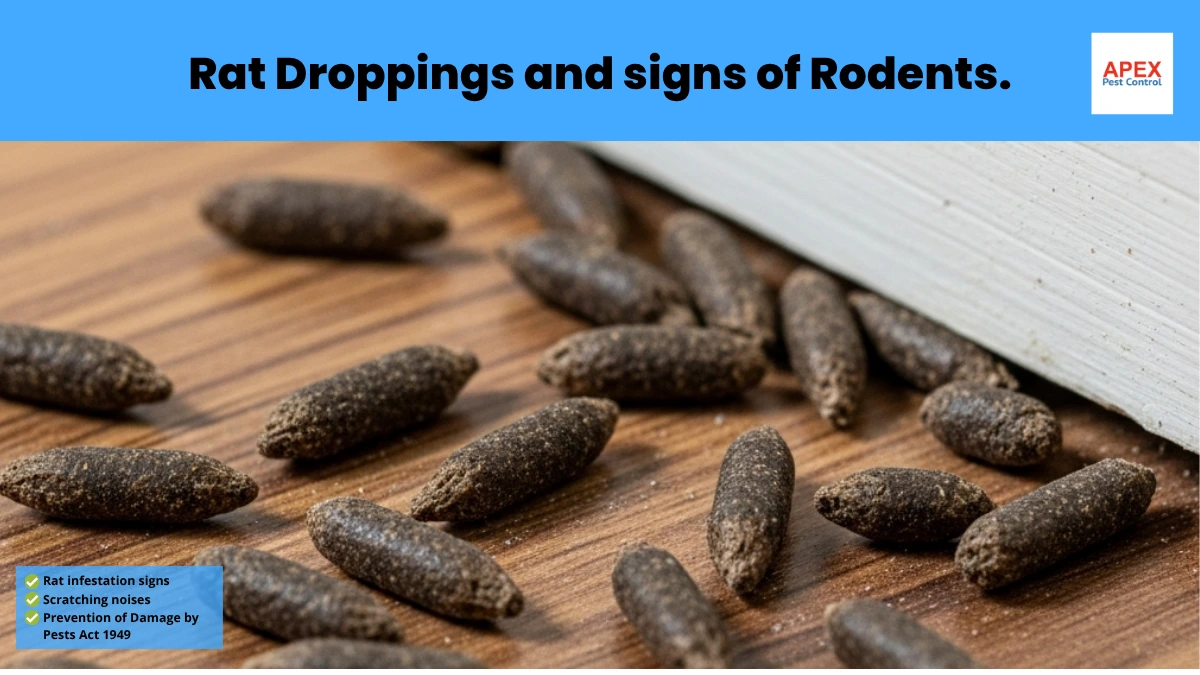
Rat droppings are usually the first and most conclusive sign of a rat infestation. Brown rats produce up to 40 droppings per night, typically deposited in concentrated areas along their regular routes — behind appliances, beneath kitchen units, inside cupboards, in loft spaces, and along skirting boards.
What to look for:
- Dark brown, capsule-shaped pellets approximately 8–12mm long
- Tapered at both ends, resembling a large grain of rice
- Fresh droppings are moist and dark; older droppings become dry, hard, and paler
- Concentrated clusters near food storage, water sources, or nesting areas
Finding droppings in multiple locations suggests rats have been present for some time and are moving freely through the property. A single cluster near a point of entry may indicate early activity.
If you find droppings, do not sweep or vacuum them without first wearing gloves and a face covering — rat droppings can carry Salmonella and other pathogens.
2. Gnaw Marks and Structural Damage
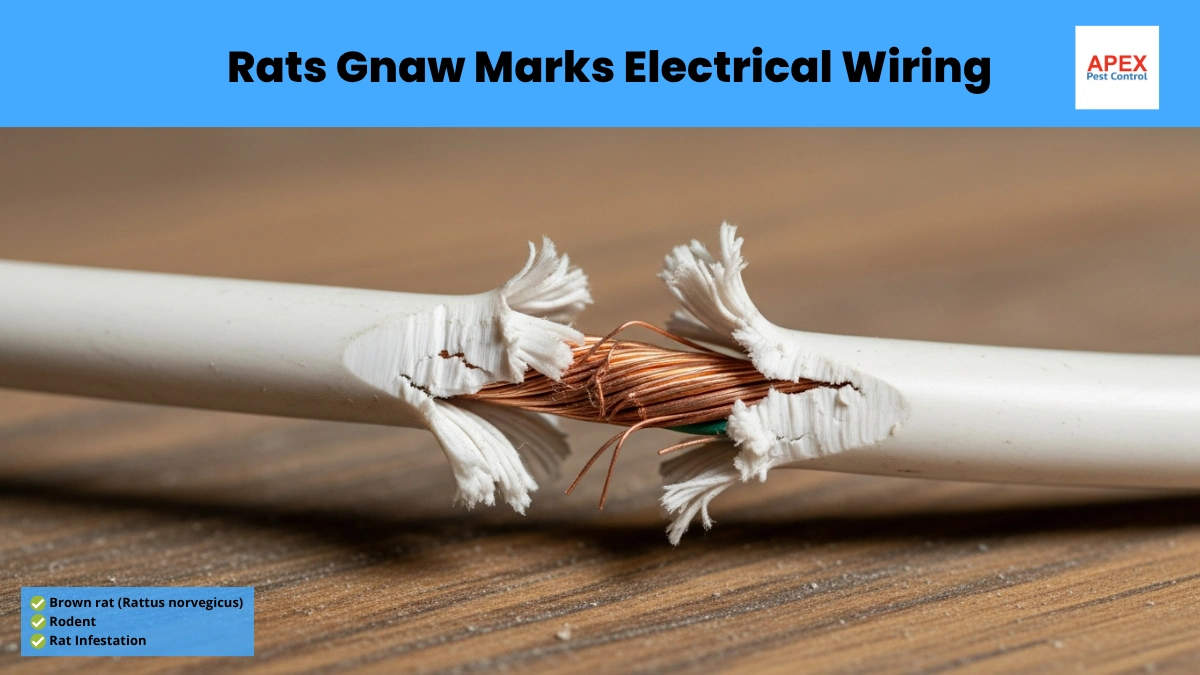
Rats must gnaw continuously to prevent their incisors from overgrowing. This means they will chew through almost anything in their path — wood, plastic, lead pipe, and electrical wiring.
Where to check:
- Skirting boards, door frames, and wooden beam edges
- Chewed wires and electrical cables behind walls, in loft spaces, and under floors
- Plastic waste pipes and water supply pipes beneath sinks
- Food packaging in cupboards or storage areas
Gnaw marks from rats are larger and rougher than those left by mice. Fresh marks appear pale and splintered; older marks darken over time. If you find exposed electrical wiring, treat it as a fire risk and contact a qualified electrician as well as pest control.
Rodents are believed to account for a significant proportion of electrical fires of unknown origin in the UK — this is one reason property owners have a legal obligation under the Prevention of Damage by Pests Act 1949 to control rat activity on their premises.
3. Grease Marks and Smear Trails
Rats have poor eyesight — they can only see up to around one metre clearly — so they navigate using established routes, following the same paths along walls, pipes, and skirting boards night after night.
As they travel, the oil and dirt in their fur leaves dark rub marks — a reliable indicator of an active rat run.
Where to look:
- Along skirting boards and wall edges at floor level
- Around pipe entry points and gaps in floorboards
- On beams, joists, and rafters in loft spaces
- Around holes or gaps in walls where rats are entering
In dusty or undisturbed areas — loft spaces, garages, under-sink cupboards — you may also find rat footprints or tail drag marks alongside these smear trails. Unusual pet behaviour — cats or dogs showing persistent, unexplained interest in skirting boards, walls, or cupboard bases — can also indicate an active rat run. Rat tracks alongside rub marks confirm regular use of that route.
Fresh rub marks are dark and slightly greasy. Old marks become dry and flaky. A well-defined run with strong marking suggests regular and prolonged use.
4. Scratching Noises
Most rats are active at night, and the sounds they make are often the clearest indicator of their presence — particularly in properties where the infestation is confined to wall cavities, subfloor spaces, or loft areas.
What you might hear:
- Scratching and scurrying sounds from within walls, ceilings, or under floorboards
- A low grinding or chattering noise — brown rats grind their teeth when stressed
- Burrowing sounds from beneath concrete, paving, or under sheds in the garden
- Movement sounds that are loudest in the early hours of the morning
If the sounds come from multiple directions or seem to be increasing in frequency, the population is likely growing. Sounds in the loft during daylight hours can indicate an infestation that has become large enough to cause rats to be active outside their normal nocturnal window.
5. Burrows and Nesting Materials
Brown rats are natural burrowers. Outdoors, they excavate tunnel systems for shelter, food storage, and nesting — typically adjacent to solid structures such as walls, paving edges, shed bases, and compost bins. Burrow entrances are typically 6–9cm in diameter with smooth, compacted edges and a clear dirt run leading away from the opening. Burrow depth typically reaches 30–45cm.
Indoors, rats build nests from shredded materials — insulation, fabric, cardboard, and paper — in undisturbed locations close to food and water. Common indoor nesting sites include:
- Beneath kitchen appliances and behind fitted units
- Inside wall cavities and between ceiling joists
- In loft insulation
- Under bath panels and behind boxing around pipework
A warm, dry nest with fresh nesting material indicates active occupation. Disturbing the nest without professional control in place risks scattering rats further through the property.
Caption: Rat burrow holes found during a real Apex Pest Control job in Yorkshire — 50 rats removed over multiple visits. This was the final inspection confirming full clearance. You can read more in our article on how to get rid of rats.
6. Unusual Smells
Rats urinate constantly as they move, marking territory and communicating with other rats. In a property with an established infestation, this produces urine stains on surfaces and a strong, persistent ammonia-like odour — particularly in enclosed areas such as under-sink cupboards, loft spaces, and wall cavities.
The smell intensifies as the population grows and as urine accumulates in nesting areas. In severe or long-standing infestations, the smell of decay may also be present if rats have died within wall or floor voids.
If pets — particularly cats or dogs — are showing unusual interest in skirting boards, walls, or cupboard bases without an obvious cause, their behaviour may be tracking rat activity the human nose cannot yet detect.
7. Rat Sightings — What It Really Means
Seeing a rat — whether in the house or in the garden — is often treated as an isolated incident. In the vast majority of cases, it is not.
Brown rats are cautious animals that avoid open spaces and unfamiliar situations. A rat seen during daylight hours, in a room rather than a wall void or garden perimeter, is typically a sign that the population has grown to the point where competition for resources is forcing subordinate animals into the open.
A daytime rat sighting inside a Leeds property should be treated as a confirmed infestation requiring professional attention — not a one-off event.
A rat spotted in the garden is more common and does not always indicate an indoor infestation, but it does signal activity on the property that should be investigated and addressed before it moves indoors — particularly as temperatures drop in autumn and winter. In Yorkshire, rat activity peaks between October and February.
The Risks: Why Leeds Property Owners Must Act Fast
Rats carry diseases transmissible to humans through contact with their urine, droppings, or contaminated surfaces.
Key health risks:
- Leptospirosis (Weil’s disease) — A bacterial infection spread through rat urine contaminating water or soil. In England, an average of 57 laboratory-confirmed cases and 89 probable cases are reported annually (UKHSA, 2020–2023). Around 10% of leptospirosis cases develop into Weil’s disease, which can cause kidney failure, liver damage, and in rare cases death.
- Salmonellosis — Spread through rat droppings and urine contaminating food preparation surfaces. Rats leave faecal matter invisible to the naked eye on every surface they cross.
- Listeriosis — Listeria monocytogenes is carried by rats and can contaminate food preparation surfaces, posing serious risk to vulnerable individuals including pregnant women and the immunocompromised.
- Property damage — Chewed electrical wiring creates fire risk; gnawed pipework causes flooding; burrowing can undermine paving and structures.
There is also a legal dimension. The Prevention of Damage by Pests Act 1949 places a legal obligation on property owners and occupiers to control rats on their premises and to notify the local authority if an infestation poses a risk to health or property.
Why DIY Rat Control Rarely Works in Leeds
Consumer rodenticides available from supermarkets and DIY stores are typically first-generation anticoagulants. While they can reduce a small population, they rarely eliminate an established colony — and rats that survive a first exposure become bait-shy, making subsequent control significantly harder.
Why DIY approaches fall short:
- Consumer products do not address entry points — rats will re-enter from drainage, gaps around pipework, or damaged brickwork
- Consumer rat traps placed without a full survey frequently miss primary activity areas and fail to clear an established colony
- Without proofing work, a property remains vulnerable to re-infestation
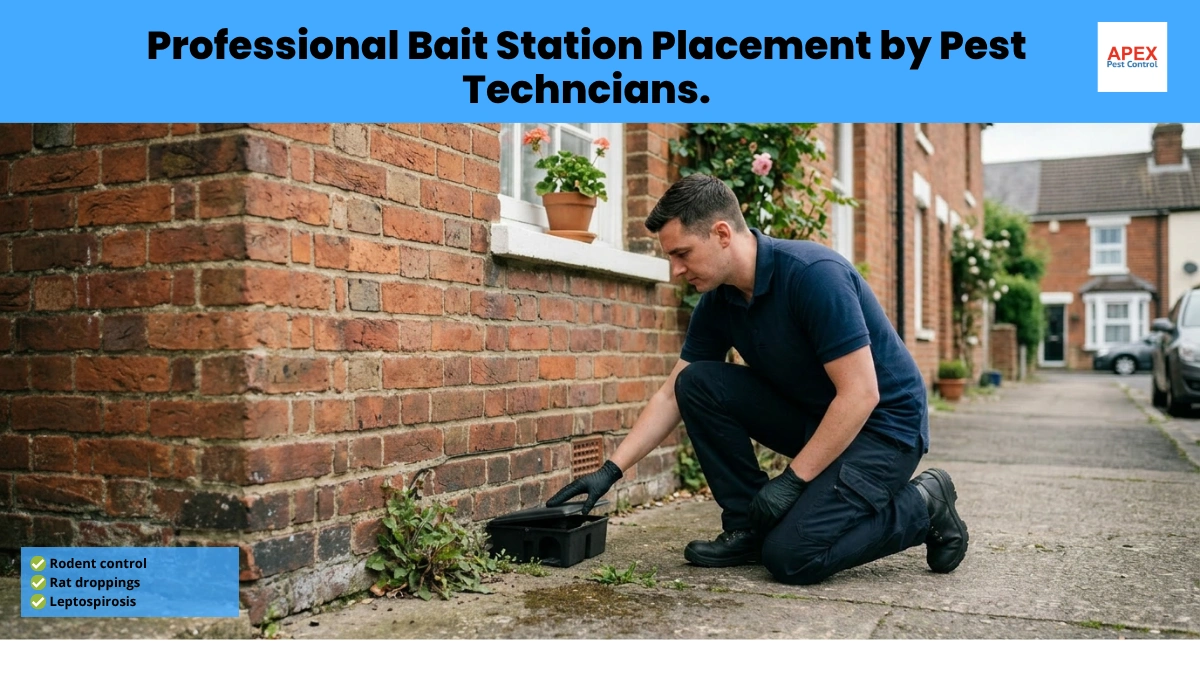
Professional pest control includes a full survey to identify entry routes, placement of tamper-resistant bait stations in the correct locations, monitoring visits to confirm activity has ceased, and proofing recommendations to prevent return.
Professional Rat Control in Leeds — What to Expect from Apex
Apex Pest Control provides BPCA-accredited rat control across Leeds, including LS1 to LS29 and surrounding areas. Our Leeds-based technician Nathan carries out initial surveys, treatment, and follow-up visits.
Rat pressure is particularly high in Leeds’s inner-city areas. Headingley, Chapeltown, Beeston, and Harehills consistently report elevated rat activity, driven by dense Victorian and Edwardian terraced housing, HMO concentrations, and the River Aire corridor which connects the urban centre to surrounding agricultural land.
Approximately 70% of rat infestations in Leeds are linked to drainage faults
A structural issue that consumer products cannot address without a professional drain inspection and proofing survey. Peak rat season in Yorkshire runs from October to February as falling temperatures push rodents indoors.
Our rat control process:
- Survey — Full inspection of the property to identify entry points, active runs, nesting sites, and the extent of the infestation. A fixed-price quote is provided on the same visit.
- Treatment — Professional-grade rodenticide applied in tamper-resistant bait stations at all identified activity points. No call-out fee.
- Monitoring visit — Return visit to assess activity, replenish bait as needed, and confirm the infestation is under control.
- Proofing advice — Recommendations to seal entry points and reduce harbourage to prevent re-infestation.
All treatments use products approved under the Control of Pesticides Regulations 1986 and are conducted in line with the CRRU UK Code of Best Practice on rodenticide stewardship. Apex holds BPCA, CHAS, NPTA, and Lantra accreditations and the Defender Award, and carries £5 million public liability insurance.
Call our Leeds team: 0113 390 4270
Frequently Asked Questions
How do I know if I have rats rather than mice?
Rat droppings are significantly larger than mouse droppings — approximately 8–12mm compared to 3–6mm for mice. Rat burrows are also much larger (6–9cm diameter versus 2–3cm for mice), and rub marks from rats are heavier and more pronounced. Sounds from rats tend to be louder and include burrowing and grinding in addition to scurrying.
How quickly can a rat infestation grow?
Brown rats can produce 8–14 litters per year with 2–8 offspring per litter. Under good conditions, a small group of rats can multiply significantly within weeks. Early intervention is always easier and more cost-effective than treating an established colony.
Can I leave it and see if they go away on their own?
Rats will not leave a property voluntarily if food, water, and shelter are available. Without removal of the infestation and identification of entry points, numbers will continue to grow.
What does professional rat treatment cost in Leeds?
Apex provides a fixed price at the survey stage with no call-out fee. Contact us on 0113 390 4270 for a same-visit quote.
How long does rat treatment take to work?
In most cases, activity reduces significantly within 7–10 days of treatment and ceases within 2–3 weeks. A monitoring visit confirms clearance.
Spotted the Signs? Call Apex Pest Control Leeds Today
If you have identified one or more of the signs above in your Leeds property, early action is the most effective response. Apex Pest Control’s Leeds team provides BPCA-accredited rat control with no call-out fee and a fixed price given at survey.
Call Nathan and the Leeds team: 0113 390 4270
Lines open Monday–Friday 8am–6pm, Saturday 9am–1pm.

Tony Johnson, Founder & Head Pest Technician at Apex Pest Control Ltd, is a BPCA and NPTA accredited pest management expert with over 40 years’ hands-on experience. Tony specialises in Integrated Pest Management and ensures all services comply with UK pest legislation, including the Wildlife and Countryside Act 1981 and COSHH Regulations 2002. His commitment to continual learning and adapting to industry best practices means clients receive effective, safe solutions for pests affecting homes and businesses across South Yorkshire and West Yorkshire. Tony’s dedication to professional standards, ethical treatment methods, and local expertise has made him a trusted partner for pest control and prevention.
- BPCA & NPTA accredited | CHAS certified.
- Committed to UK pest law compliance & safety.
- Focused on effective, ethical pest management for Yorkshire, UK.