Wasp Nest Removal in Leeds Cost, Process & Complete Safety Guide
Found wasps flying in and out of the same spot on your property? That flight line almost always means an active nest. Every summer across Leeds, homeowners and businesses discover wasp colonies in loft spaces, wall cavities, soffits, and garden structures — often weeks after the colony has been quietly building.
This guide covers everything you need to know. Queen wasp behaviour, how colonies grow, why certain properties get nests more than others, what professional treatment involves, how much it costs, and what to do if someone is stung. Written by the team at Apex Pest Control — BPCA certified, Leeds-based, 7 days a week.
How Wasp Colonies Start — The Queen’s Role
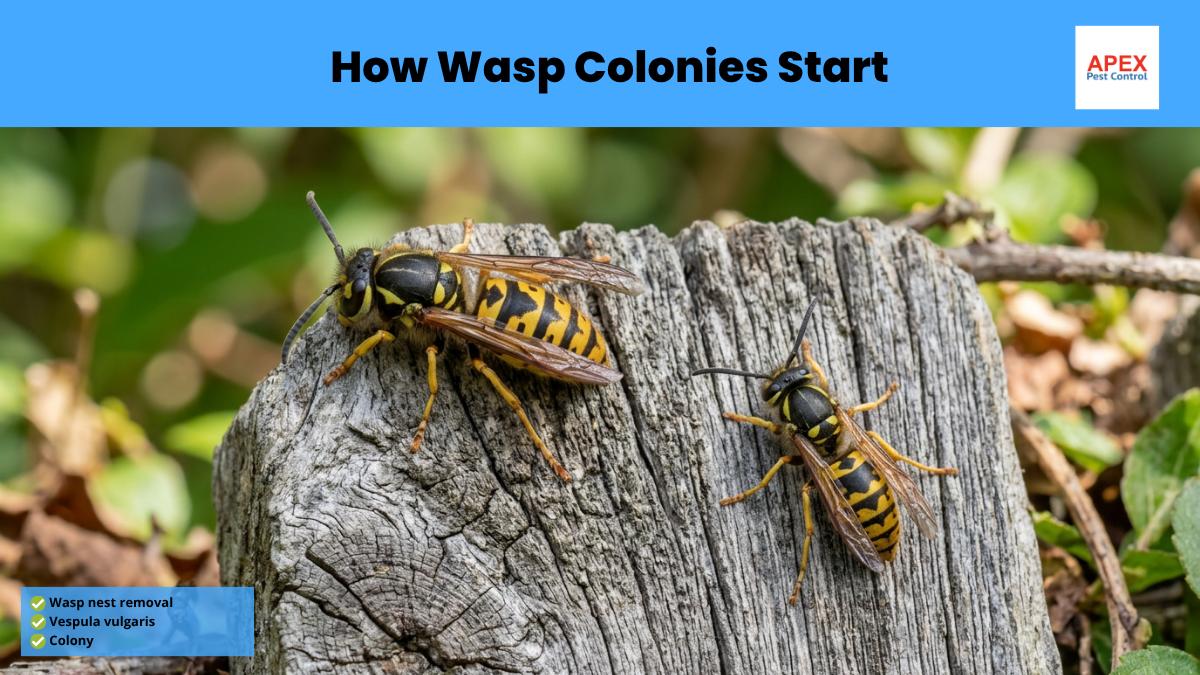
Every wasp nest begins with a single queen. In autumn, mated queens leave the dying colony to find a sheltered spot to overwinter. They tuck into wall voids, roof insulation, loose bark, or dense garden vegetation. The colony does not survive winter. Only the queen does.
Over winter, queen wasps enter diapause — a state of reduced metabolic activity that allows survival without food. They bite into the surface they are resting on and hang in place, conserving fat reserves until spring temperatures rise.
From March onwards the queen emerges and starts building alone. She chews wood from fences, dead timber, or garden structures, mixing it with saliva to produce the papery material that forms each cell. She builds 20 to 30 cells first, lays an egg in each, and raises the first worker wasps herself. Once those workers emerge, they take over all construction and foraging while the queen focuses entirely on laying — up to 200 to 300 eggs per day at peak.
This is why early treatment is significantly easier, cheaper, and less risky. A nest found in April or May is a small structure with a handful of workers. The same nest left until August is a different problem entirely.
How Big Do Wasp Nests Get?
Colony size is what most homeowners underestimate — and it matters when deciding how quickly to act.
By late June, a nest may contain several hundred workers. By July, several thousand. At peak season — typically late August into early September — an average nest holds between 2,000 and 5,000 wasps. A large, well-established nest under ideal conditions can contain up to 10,000 or more. A single queen wasp produces between 6,000 and 10,000 workers across a full season.
Physically, a nest starts the size of a golf ball in spring. By September it can be the size of a football or larger. The structure grows continuously as workers add new layers to accommodate the expanding colony.
By late September the colony begins to decline. New queens and male drones have been produced, mating flights occur, and the founding queen dies. Workers gradually disperse and the nest is abandoned. Wasps never reuse an old nest — each queen builds entirely fresh the following spring. However, new queens may return to the same location if it previously offered suitable conditions. A treated nest left in place retains residual insecticide that deters new queens from selecting the same site.
Why South-Facing Properties and Roof Voids Get More Nests
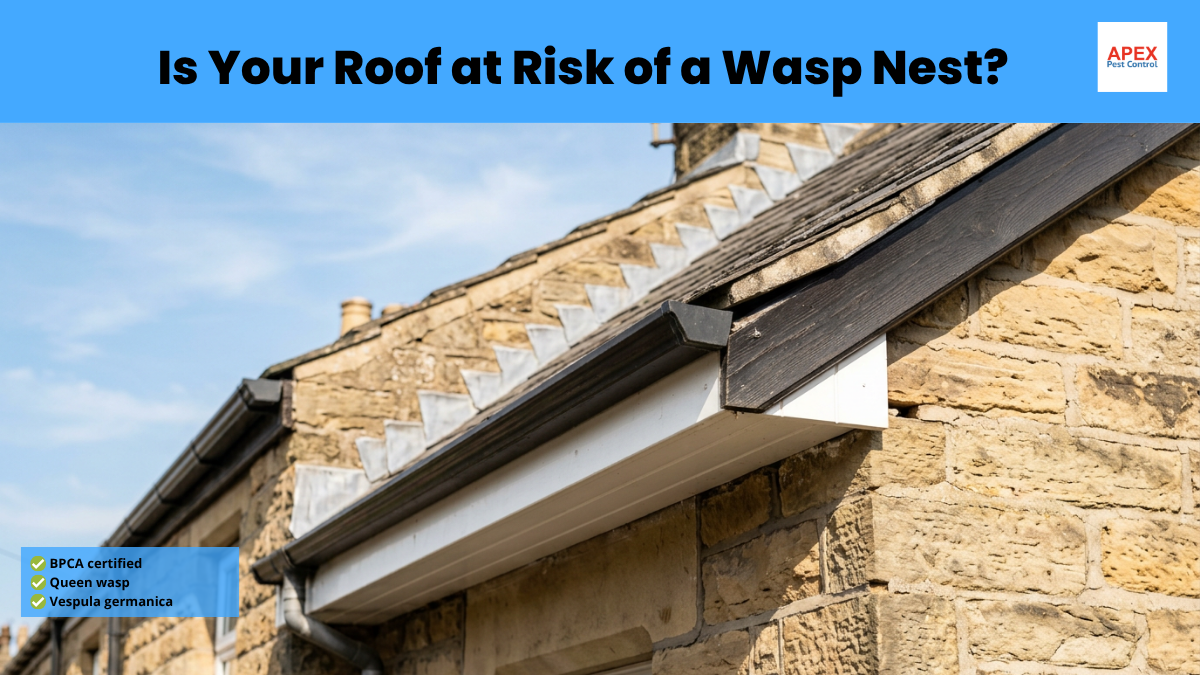
Warmth is the primary driver of nest site selection. Warmer conditions accelerate larval development and colony growth. South-facing and southwest-facing roof voids, walls, and garden structures receive the most direct sunlight across the day — which is why they are disproportionately represented in wasp nest call-outs across suburban Leeds every summer.
Loft spaces facing south retain the most heat. They also offer shelter from weather, protection from predators, and minimal disturbance — everything a queen wasp looks for when selecting a nest site. This combination makes loft spaces the single most common wasp nest location in Leeds residential properties.
The most frequent nest sites in Leeds homes and gardens are:
Loft spaces and roof voids — the most common call-out type, particularly in the older terraced and semi-detached housing stock across Roundhay, Moortown, Alwoodley, and Headingley. Wasps access through gaps in fascias, soffits, and broken or missing roof tiles.
Wall cavities and air bricks — sheltered inside the building fabric. Nests in cavities can be difficult to locate precisely and require careful treatment to reach the interior.
Roof eaves and soffits — visible from outside, often the easiest to identify from the consistent flight line at the entrance point.
Garden sheds, garages, and outbuildings — particularly where roof joins or gaps in boarding provide access to undisturbed interior space.
Underground burrows in garden borders and lawns — less common but present across Leeds, often linked to old rodent runs or soft soil near tree roots.
Wasp, Bee, or Hornet? Getting the Identification Right
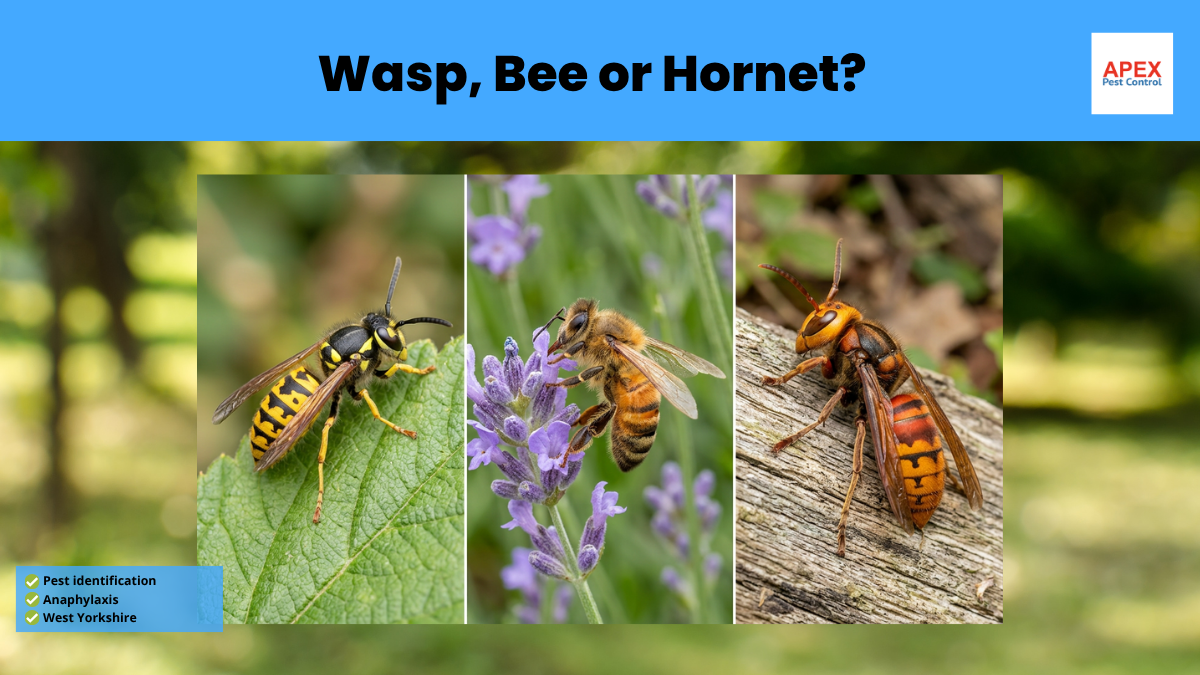
Correct identification before any treatment is essential. Honey bees are frequently mistaken for wasps. They cannot be treated with insecticide — doing so without proper justification is illegal under UK wildlife legislation. A BPCA qualified technician will always confirm the species before any treatment begins.
Wasp nests are grey and papery, made from chewed wood pulp. They have a layered outer shell with a single entrance hole. The texture looks similar to papier-mâché.
Honey bee colonies produce honeycomb — hexagonal beeswax cells with no outer covering. Bee nests have significantly more insect activity at the entrance and bees are noticeably hairier than wasps.
Hornets are much larger than common wasps, with a reddish-brown thorax and brown and yellow banding rather than black and yellow. If you have hornets, the nest will be larger and typically positioned higher up — in tree cavities, larger roof voids, or outbuilding roofs.
The two species most commonly found in Leeds are the common wasp (Vespula vulgaris) and the German wasp (Vespula germanica). Both are black and yellow, both around 12 to 17mm long. The German wasp has three small black dots on its face and is marginally larger. It also tends to be more defensive when disturbed. If you are not sure what you are dealing with, that is exactly what a professional assessment is for.
What Professional Wasp Nest Treatment Involves
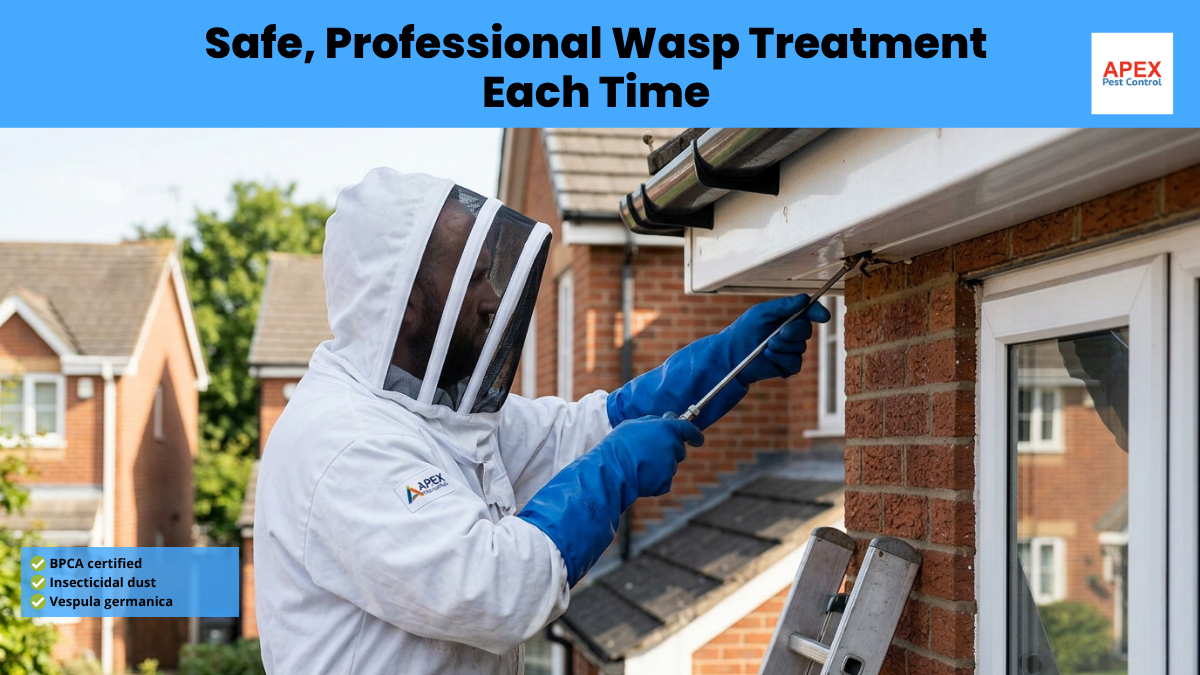
A professional treatment from Apex Pest Control is a single visit in the large majority of cases.
Nathan, your dedicated Leeds technician, will locate the nest entrance, confirm the species, and assess nest size and position. A professional-grade insecticidal dust is applied directly into the nest entrance. Individual wasps that contact the product die within minutes. As foragers return to the nest throughout the day, they carry the insecticide inside and spread it through the interior — reaching the queen and brood cells. The colony is typically eliminated within 24 to 48 hours.
Wasp activity at the entrance will increase briefly after treatment as returning foragers contact the product. This is a normal and expected part of the process — it means the treatment is working. It settles within a few hours.
You do not need to leave the property during treatment. You do not need to remove the nest once treatment is complete. The structure deteriorates naturally over the following weeks as no workers remain to maintain it.
If you want the nest physically removed from a loft space — for peace of mind or to discourage future nest selection at the same site — this is available as a separate service once the colony is confirmed dead.
Is Wasp Nest Treatment Safe for Pets and Children?
Professional insecticidal treatments are applied at controlled doses directly into the nest entrance — not sprayed broadly across the property. The risk to pets and children inside the home during treatment is minimal. That said, sensible precautions apply.
Keep children and pets away from the nest entrance during the visit and for the first few hours after treatment, until wasp activity has fully settled. Once the treated surface is dry and no active wasps remain, the area is safe for normal household use. Your technician will advise on specific waiting times based on the product used and the nest location.
For loft nest treatments, there is no direct contact risk for pets or children in the living areas of the property at any point.
If DIY products are being considered, never use aerosol sprays in enclosed spaces such as lofts or wall cavities where children or pets could be exposed to concentrated product in a confined area. Professional treatments use the correct product at the correct dose — more effective and significantly safer than anything available over the counter.
Wasp Stings and Anaphylaxis — Knowing the Signs
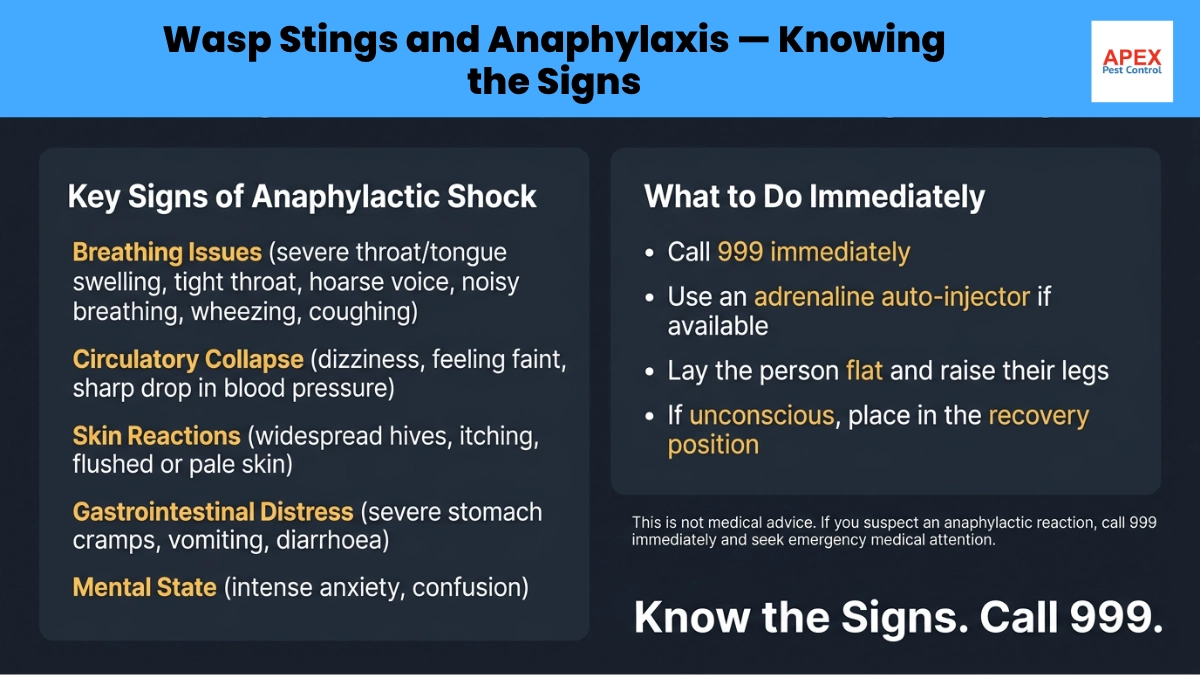
For most people, a wasp sting causes localised pain, redness, and swelling that settles within a few hours. For around 1% of the UK population, a wasp sting can trigger anaphylaxis — a severe, whole-body allergic reaction that is a medical emergency.
Anaphylaxis UK estimates approximately ten deaths per year in the UK from wasp and bee sting reactions. Unlike a honey bee, a wasp can sting multiple times. A disturbed colony responds collectively — the risk from a provoked nest is not a single sting, it is a coordinated defensive response from thousands of workers simultaneously.
Symptoms of anaphylaxis following a wasp sting include:
Difficulty breathing or swallowing. Swelling of the tongue or throat. A sudden drop in blood pressure causing dizziness, faintness, or collapse. A hoarse or changed voice. Hives or widespread skin redness spreading rapidly beyond the sting site. Nausea or stomach cramps. A sudden overwhelming sense of feeling very unwell — sometimes described as a feeling of impending doom. These are not mild symptoms. They escalate quickly.
Most severe reactions begin within minutes of the sting. Life-threatening reactions typically occur within 30 minutes.
If you or anyone present shows these symptoms after a wasp sting, call 999 immediately. Tell the operator you suspect anaphylaxis. If the person has a prescribed adrenaline auto-injector, use it straight away — do not wait to see whether symptoms worsen. Lay the person down. Do not allow them to stand or walk, even if they feel briefly better. If symptoms have not improved after five minutes and a second auto-injector is available, use it.
If you have previously experienced a large localised reaction to a wasp sting — significant swelling beyond the sting site that worsened over 24 to 48 hours — speak to your GP. This can indicate a higher risk of a systemic reaction in future. People with a known venom allergy should carry a prescribed adrenaline auto-injector throughout wasp season.
Professional nest treatment eliminates the colony and removes the ongoing sting risk entirely. For households with a member who has a known venom allergy, early treatment of any active nest is strongly recommended.
Should You Treat a Wasp Nest Yourself?
Aerosol wasp sprays from hardware shops have a role, but a limited one. They do not penetrate deep enough into a nest structure to reach the queen and core brood cells. Partial treatment leaves a surviving colony that will rebuild. Attempting to knock a nest down or block an entrance without killing the colony first triggers an immediate defensive response.
Specific risks with DIY treatment include working at height on a ladder while under wasp attack, no access to professional-grade residual insecticides, inadequate protective equipment for a large colony, and — for some home remedies — genuine fire risk near a highly flammable paper structure.
For small, newly established nests in early June in accessible outdoor locations, some homeowners manage DIY treatment successfully. For any nest in a loft, wall cavity, or underground location — or any nest that is large, near a regular entry point, or near a family member with a venom allergy — professional treatment is the right call.
How Much Does Wasp Nest Removal Cost in Leeds?
Wasp nest removal prices across Leeds vary more than most people expect — and understanding why helps you make the right call for your property, not just the cheapest one.
At the lower end of the market, sole traders and unaccredited operators typically charge between £45 and £65 for a standard treatment.
At the mid-market level, established local companies sit in the £65 to £85 range. BPCA certified professionals — independently audited, insured to a minimum of £2 million, and trained to national industry standards — typically start from £80 upwards, with loft removals and difficult-access nests priced higher.
The price gap between the cheapest and the most professional option in Leeds is often £20 to £40. It is worth understanding what that difference buys.
A lower-cost operator may use over-the-counter grade products rather than professional-use insecticides. They may not carry public liability insurance adequate to cover property damage during treatment. They are unlikely to carry out a species identification check before applying treatment — which matters if what you have turns out to be a honey bee colony rather than a wasp nest. And if the treatment does not work first time, you are starting from scratch.
A BPCA certified technician has been assessed against BS EN 16636 — the British Standard for professional pest management. They carry professional-grade products not available to the public, use correct application methods for each nest type and location, confirm the species before treatment begins, and provide documented evidence of the work carried out. That documentation is particularly relevant if you are a landlord, a business, or if the nest is in a shared or rented property.
It is also worth checking whether a quoted price includes a call-out fee — some operators quote a low headline figure and add a call-out charge on top. Others quote for one nest and charge separately for additional nests found on arrival.
Apex Pest Control pricing for Leeds — all plus VAT, no call-out fee:
Wasp nest treatment (standard, 1 visit): from £80 Additional nest at the same property, treated in the same visit: £20 per nest Wasp nest removal from a loft (killed and physically removed if accessible): £120
The price quoted at booking is the price on your invoice. No call-out fee, no surprises. Nathan has treated hundreds of wasp nests across Leeds LS postcodes — from early-season nests in garden sheds to large late-August loft colonies requiring full protective equipment and careful product placement. When you book with Apex, you are not rolling the dice on whether the treatment will work. You are booking a qualified technician who has seen every variation of this problem and knows exactly how to resolve it.
Wasp and Hornet Nests Apex Have inspected and Treated
The short video shows the small gap under the window where the wasp nest entrance is and was treated.
Here we were called out to a hornets nest in the roof space of a home stopping a roofing company from completing home maintenance.
Commercial Wasp Nest Removal — What Businesses Need to Know
An active wasp nest on commercial premises is not just an inconvenience — it carries legal weight. Under the Health and Safety at Work etc. Act 1974, employers have a statutory duty of care to protect the health and safety of employees and visitors. A known nest that is left untreated, particularly in a high-footfall area, represents a foreseeable and documentable risk.
This applies across all commercial environments — offices, warehouses, food production facilities, hospitality venues, schools, care homes, and retail sites. Food businesses face additional obligations under the Food Safety Act and Environmental Health Officer requirements. Pest activity — including wasps — can result in enforcement action if not properly managed and evidenced.
A professional treatment with a written service report provides documented evidence that the risk was identified and addressed. That documentation matters in the event of a staff injury, a public liability claim, or a regulatory inspection.
Apex Pest Control holds 320 active commercial contracts across Yorkshire, operating to EHO, BRCGS, and CQC compliance standards. Commercial wasp nest treatment is available across all Leeds LS postcodes. Call 0113 390 4270 for a free site assessment and fixed-price quote.
Why Choose Apex Pest Control for Wasp Nest Removal in Leeds
Nathan Marshall, your dedicated Leeds technician, is BPCA qualified, COSHH 2002 compliant, and Wildlife and Countryside Act 1981 compliant. He has treated hundreds of wasp nests across Leeds — from compact garden shed nests in June to large established loft colonies in late August.
When you call Apex, you speak directly to the team — not a call centre. The technician who answers knows the area and will be the person who attends your property. The price quoted at booking is the price on your invoice. All plus VAT. Nothing added, nothing hidden.
Apex is available Monday to Friday 8am to 7pm and Saturday to Sunday 8am to 1pm — seven days a week, because a wasp nest found on a Saturday does not wait until Monday.
Treatment is backed by a 100% resolution rate for customers who follow the treatment plan as advised. Your technician will confirm exactly what is needed at the visit.
Call now for a free quote — no call-out fee: 0113 390 4270
Or visit the Leeds wasp nest removal page for full service details and to make an enquiry.
Apex Pest Control Ltd — BPCA member, CHAS accredited, £5M public liability insurance. Covering all LS postcodes across Leeds.
For more information on wasp nest around your home, be sure to read our Free E-book – The Homeowner’s Guide to Wasps & Hornets: A Practical UK Guide to Understanding, Preventing and Dealing with Wasp and Hornet Problems on Google Play Store.

Tony Johnson, Founder & Lead Technician at Apex Pest Control, is a BPCA and NPTA accredited pest management expert with over 35 years’ hands-on experience. Tony specialises in Integrated Pest Management and ensures all services comply with UK pest legislation, including the Wildlife and Countryside Act 1981 and COSHH Regulations 2002. His commitment to continual learning and adapting to industry best practices means clients receive effective, safe solutions for pests affecting homes and businesses across South Yorkshire. Tony’s dedication to professional standards, ethical treatment methods, and local expertise has made him a trusted partner for pest control and prevention.
-
BPCA & NPTA accredited | CHAS certified
-
Committed to UK pest law compliance & safety
-
Focused on effective, ethical pest management for South Yorkshire